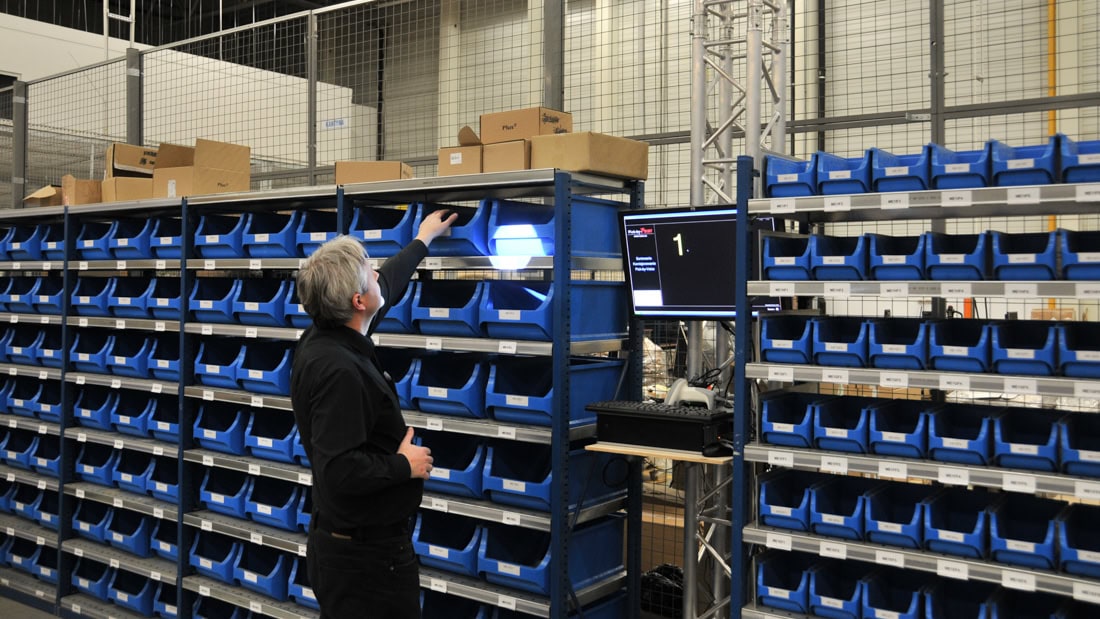
Picking encompasses all processes involved in removing items from inventory and assembling them into orders—from basic principles and organizational structures to modern picking systems.
What is order picking?
Picking is a logistics process in which items are removed from inventory in accordance with an order and assembled into a shipment, production unit, or dispatch. It is one of the core functions of intralogistics and integrates warehousing, material flow, and order processing.
In modern warehouses, order picking is often supported by digital systems. Technologies such as Pick by Light, Pick to Light, scanner solutions, or voice-guided systems help quickly locate picking locations, prevent errors, and efficiently manage picking processes.
Definition of Order Picking
In logistics, order picking refers to the process of selecting individual items from a total inventory to fulfill a specific order. This process is based on customer orders, production requirements, or internal material requests.
Picking is typically based on order data from a warehouse management system (WMS) or ERP system. Employees are directed to the appropriate storage locations, retrieve the required quantities, and confirm the picks in the system. The picked items are then forwarded to packaging, shipping, or production.
Purpose and Benefits of Order Picking
The goal of order picking is to assemble orders quickly, accurately, and efficiently from the available inventory. It is a central component of order fulfillment and has a significant impact on a warehouse’s performance.
Well-organized order picking ensures that customer orders can be delivered on time, production lines are reliably supplied with materials, and warehouse processes remain cost-effective. At the same time, it helps reduce error rates and increase transparency in the flow of materials.
Distinction from Warehousing, Shipping, and Material Flow
Picking is part of overall warehouse logistics, but it is clearly distinct from other processes such as storage, transportation, or shipping.
While warehousing refers to the long-term storage of goods in a warehouse, order picking focuses on the targeted removal of individual items from the inventory. Shipping does not begin until after order picking is complete, when the assembled items are packaged and delivered to the customer.
Within a company’s material flow, order picking thus serves as the link between warehousing and order fulfillment. It determines how quickly and reliably goods are moved within a warehouse.
Objectives of Order Picking
Picking is one of the most labor-intensive processes in warehousing and intralogistics. The goal is to fulfill customer orders or production requirements as quickly, accurately, and cost-effectively as possible using existing inventory.
Since a large portion of warehouse costs is attributable to picking processes, the organization of picking plays a crucial role in a warehouse’s efficiency. Modern picking systems and optimized processes help to sustainably improve throughput, quality, and cost-effectiveness.
High picking performance and short turnaround times
A key objective of order picking is to achieve the highest possible picking rate. This refers to the number of items that can be picked within a given time frame.
Efficient warehouse organization, optimized walking routes, and the use of digital assistance systems can significantly reduce processing times. Employees can locate the correct storage locations more quickly, picking is faster, and orders can be transferred to shipping or production more quickly.
Low error rate and high process reliability
In addition to speed, accuracy is a critical factor in order picking. Picking errors lead to returns, production downtime, or additional processing costs.
Digital picking systems help employees identify items and storage locations. Technologies such as scanner solutions, voice-guided systems, and light-guided picking help reduce errors and improve process reliability in the warehouse.
Ergonomics and Cost-Effectiveness in the Warehouse
Another goal of modern picking processes is to design workflows in an ergonomic and cost-effective manner. Long walking distances, heavy loads, or confusing warehouse layouts can negatively impact productivity and working conditions.
Appropriate warehouse planning, ergonomic workstation design, and the use of assistive technologies can help reduce workloads and search times. At the same time, companies can increase their picking efficiency and lower operating costs in the long term.
The Process of Order Picking
The picking process describes the individual steps involved in removing items from inventory and assembling them into an order. In most warehouses, picking follows a fixed sequence of steps controlled by a warehouse management system (WMS).
The process may vary depending on the warehouse layout and the technology used. However, the basic steps remain similar in most picking systems and range from order acceptance to the transfer of the picked goods to shipping or production.
Order Acceptance and Picking Start
The picking process begins with the retrieval of an order from the ERP or warehouse management system. This order contains all relevant information, such as item numbers, quantities to be picked, and storage locations.
The system transmits this data to the respective picking systems. Employees then receive their work instructions via displays, scanners, mobile devices, or voice-guided systems, for example.
Directions to the storage area
In the next step, employees are guided to the correct storage location. Depending on the technology used, navigation is provided via digital displays, mobile devices, or visual cues in the warehouse.
Efficient routing is crucial to picking performance, as a large portion of working time in the warehouse is spent walking. Modern picking systems help optimize routes and minimize search times.
Item Picking and Quantity Check
At the picking station, the employee retrieves the required items from the storage bin or shelf. The required quantity is displayed by the picking system or transmitted via a mobile device.
During the picking process, the item number or quantity is often double-checked to prevent picking errors.
Pick Confirmation and Feedback to the System
After the item is picked, the pick is confirmed in the system. This can be done in various ways, such as by scanning a barcode, pressing a button, triggering a sensor, or using a voice command.
The confirmation is transmitted to the warehouse management system in real time, ensuring that the current status of the order can be tracked at any time.
Transfer to shipping, production, or the next process
Once picking is complete, the assembled items are transferred to the next step in the process. In distribution centers, for example, the goods are sent to the packaging and shipping areas.
In production logistics or assembly supply, the picked materials are often sent directly to production lines or workstations.
What are the different picking principles?
The organization of the picking process depends heavily on the underlying warehouse layout. A distinction is made between whether employees move to the items or whether the goods are transported automatically to the picking station.
These fundamental principles determine the design of warehouse layouts, material flow, and picking systems. Depending on the size of the warehouse, order structure, and level of automation, different picking principles are used.
Generally speaking, there are three key principles of order picking.
Person-to-Goods Principle
Under the "man-to-goods" principle, employees move through the warehouse and retrieve items directly from their respective storage locations. This method is particularly common in manual warehouse setups with racks, shelving systems, or pallet storage areas.
Pickers follow a predetermined route through the warehouse and collect the items required for an order one by one. Digital assistance systems such as Pick by Light, Pick to Light, scanner solutions, or voice-guided systems assist employees with navigation and picking.
The "man-to-goods" principle offers a high degree of flexibility and is particularly well-suited for warehouses with a wide variety of items or highly fluctuating order volumes.
Goods-to-Person principle
Under the "goods-to-man" principle, items are automatically transported to a fixed picking station. Employees remain at a single station while conveyor systems, shuttle systems, or warehouse robots deliver the required storage bins or pallets.
Since there is no need to walk around the warehouse, picking processes can be significantly accelerated. At the same time, workstations can be designed ergonomically, as employees can retrieve goods at an optimal reaching height.
This principle is frequently used in automated warehouse systems, such as shuttle warehouses, AutoStore systems, or robot-assisted picking solutions.
Fully automated order picking
In fully automated order picking, machines or robotic systems handle the retrieval of items entirely. Robots pick the products directly from the warehouse and automatically assemble the orders.
Such solutions are primarily used in highly automated logistics centers or where throughput requirements are very high. They enable high processing speeds and consistent picking quality.
Despite increasing automation, many warehouses will continue to use hybrid systems that combine automated warehouse technology with manual picking processes.
Organization of Order Picking
The picking process describes how orders are organized, managed, and fulfilled in the warehouse. It specifies how items are picked, the sequence of steps involved, and how employees collaborate during the picking process.
In particular, the order structure, warehouse size, and the number of orders being processed simultaneously play a key role. A well-planned organizational structure is essential for achieving short turnaround times, low error rates, and high efficiency in the warehouse.
The specific implementation of these processes is carried out using various picking methods, which are used in the warehouse depending on requirements.
The Impact of Order Structure on the Organization
The structure of orders has a significant impact on the organization of order picking. Small, individual orders often require different processes than large or standardized order quantities.
While simple and straightforward processes are sufficient for orders with few items, large orders or high order volumes require a more structured and coordinated approach.
Organization by throughput and warehouse size
The size of the warehouse and the desired throughput also influence how picking operations are organized. In smaller warehouses, processes can often be designed to be simpler and more straightforward, whereas in large warehouses, a clear structure and division of labor are necessary.
As the number of orders and items increases, efficient organization of the picking process becomes increasingly important.
The Interplay Between Organization and Technology
The organizational structure of the picking process forms the foundation for the implementation of technical systems. Only with the right structure can picking systems fully realize their benefits.
Depending on the organization, various technologies are used to support employees in the picking process and help increase efficiency.
What are the different picking methods?
Modern warehouses use a variety of technologies to support the picking process. These systems guide employees through the picking process, display the quantities to be picked, or enable direct feedback to the warehouse management system.
Depending on the warehouse layout, product variety, and order volume, different picking methods are used. They differ primarily in how information about storage locations, items, and picking quantities is communicated to employees.
The most important picking methods include light-guided, scanner-based, and voice-guided systems, as well as mobile and specialized solutions.
Light-guided picking
In light-guided picking, employees are guided directly to the storage location by visual signals. LED displays or light indicators show the pickup location and the required quantity. After the item is picked, the pick is confirmed via a button or sensor.
This method enables particularly fast and error-free picking processes, as the correct storage location is immediately identifiable. Light-guided systems are frequently used in areas with high picking frequencies.
Among the best-known methods are:
Scanner-assisted picking
In scanner-based systems, items and storage locations are identified using barcodes or RFID technology. Employees scan the storage location or the item to confirm the withdrawal.
This method offers a high degree of flexibility and is frequently used in warehouses with a wide variety of items. Scanner solutions are particularly common in mail-order businesses, spare parts warehouses, and production logistics.
A typical procedure is:
Voice-Picked Order Fulfillment
In voice-guided picking, employees receive their work instructions through a headset. The system announces the storage location and the quantity to be picked via voice prompts, while employees confirm the picks using voice commands.
Since both hands remain free, this method is particularly well-suited for mobile picking processes that involve a lot of walking. Voice systems are frequently used in large distribution centers.
A well-known method is:
Mobile picking systems
Mobile picking solutions use portable devices or mobile workstations to assist warehouse staff. These include, for example, tablets, smartwatches, or picking carts with built-in IT.
These systems enable flexible order processing and can be integrated relatively easily into existing warehouse processes.
Typical examples include:
Specialized Picking Solutions
In addition to traditional picking systems, there are various specialized solutions designed for specific processes or industry requirements. These systems support, for example, sorting processes, visual sorting, or additional control mechanisms.
They are often used in conjunction with other picking methods.
Examples include:
Pick-by-Vision and smart glasses-based order picking
When picking orders using smart glasses—often referred to as “pick by vision” —employees receive their work instructions directly in the field of view of their smart glasses. Information about the storage location, item, and quantity to be picked is displayed using augmented reality technology.
This technology was the subject of intense debate a few years ago, but it has not gained widespread adoption in many warehouse environments. For more information on how this method works and how it is evaluated, see our article " Pick-by-Vision" in order picking.
In practice, many warehouses therefore continue to rely on proven technologies such as Pick by Light or Pick to Light, which visually guide employees through the picking process and enable particularly fast and error-free picking.
Which picking method is the right one?
The choice of the appropriate picking method depends heavily on the specific requirements of the warehouse. Factors such as order structure, product variety, warehouse size, and desired processing speed play a decisive role in this decision.
While some warehouses benefit from very fast visual picking systems, others require solutions that offer high flexibility or support mobile workflows. In practice, the optimal method is therefore always determined based on the specific warehouse processes and conditions.
The Right Method Based on Order Structure
The structure of the orders has a major impact on the choice of picking method. In warehouses with many small orders and few items per order, fast and intuitive systems are particularly important.
Light-guided methods such as Pick by Light are particularly well-suited in such cases, as they guide employees directly to the correct storage location and visually display the quantities to be picked. This allows orders to be processed quickly and with a low error rate.
For more complex orders or highly variable product structures, however, flexible systems such as scanner solutions or mobile picking systems can offer advantages.
The right method based on product range and number of items
The size and structure of the product range also influence the choice of picking system. Warehouses with a very large number of different items often require flexible solutions that can be easily adapted to changing storage locations and items.
Scanner-based picking systems or mobile solutions offer a high degree of flexibility in this context. In areas with many frequently requested items, however, light-guided systems can demonstrate their strengths, as they enable particularly fast picking processes.
The right method based on throughput and error tolerance
In distribution centers with high order volumes, the speed of order picking plays a crucial role. At the same time, error rates must be kept as low as possible, since incorrect picks can lead to returns or production interruptions.
Systems with visual or automated assistance help clearly identify picking locations and reduce errors. Light-guided picking systems are therefore frequently used, especially in areas with high picking frequencies.
Modern systems such as Pick to Light visually guide employees during picking and enable particularly fast picking processes while maintaining a low error rate.
The Right Method Based on the Level of Automation
Another key factor is the desired level of automation in the warehouse. While smaller warehouses often rely on manual or semi-automated systems, large distribution centers are increasingly turning to automated warehouse technology.
Depending on the level of automation, different technologies can be combined. In many modern logistics centers, for example, automated warehouse systems are combined with supporting order-picking technologies to achieve both flexibility and high processing speeds.
Where are order picking systems used?
Picking systems are used in many areas of logistics, wherever goods need to be retrieved from inventory and assembled into orders. Requirements regarding speed, product variety, error rates, and the degree of automation vary depending on the industry.
While some applications require particularly high picking performance, in other areas the focus is on process reliability, traceability, or ergonomic workflows. Modern order-picking systems can therefore be flexibly adapted to different warehouse and production environments.
Order Fulfillment in E-Commerce and Mail-Order Business
In e-commerce, a large number of small orders often need to be processed in a short period of time. Order volumes increase significantly, especially during seasonal peaks or promotional periods.
Picking systems help to assemble orders quickly while keeping error rates low. Visual systems or mobile picking solutions help employees quickly find their way around the warehouse and enable the efficient processing of large order volumes.
Order Picking in Industry and Manufacturing
In production environments, order picking is often used to supply materials to production lines. Parts, components, or assemblies must be delivered to the workstation at the right time.
Reliable order picking is particularly important here, as missing or incorrect items can lead to production interruptions. Digital assistance systems help employees assemble production orders correctly.
Order Fulfillment in Spare Parts Logistics and Retail
Spare parts warehouses are often characterized by a very wide variety of items. At the same time, many orders are processed with only a few items per order.
Picking systems help locate storage locations quickly and clearly identify items. Especially when dealing with large product ranges, these technologies help reduce search times and prevent errors.
Order Picking in the Pharmaceutical, Healthcare, and Sensitive Sectors
In industries such as pharmaceuticals, medical technology, and healthcare, safety and traceability requirements are particularly stringent. In these sectors, picking processes must often be documented and traceable.
Support systems help clearly identify items, document processes, and prevent picking errors. This enables companies to meet regulatory requirements while ensuring efficient warehouse operations.
How can the picking process be optimized?
Picking is one of the most time-consuming and cost-intensive processes in a warehouse. In many companies, a large portion of working hours is spent searching for, retrieving, and assembling items. Targeted optimization of picking processes can therefore lead to significant efficiency gains.
In addition to a suitable warehouse layout, optimized walking routes, supportive technologies, and ergonomic workplace design play a particularly important role. Modern order-picking systems help companies sustainably improve throughput, process reliability, and working conditions.
Reduce walking distances and search times
A significant portion of the time spent on order picking is taken up by walking around the warehouse. Long walking distances or confusing warehouse layouts mean that employees spend a lot of time searching for items.
Optimized warehouse organization, a logical layout of storage locations, and clear signage can significantly reduce walking distances. Support systems can also help locate storage locations more quickly and minimize search times.
Systematically Prevent Picking Errors
Picking errors result in additional costs due to returns, backorders, or production downtime. Therefore, reducing errors is one of the most important goals of process optimization.
Digital assistance systems help employees clearly identify storage locations and items. Visual or scanner-based systems help verify picks and detect errors in the picking process early on.
Increase Picking Efficiency with Assistive Systems
The use of modern picking systems can significantly increase warehouse productivity. Digital systems guide employees directly to the correct storage location and display the required quantities to be picked.
This reduces search times and clearly structures workflows. At the same time, employees can work faster without increasing the error rate.
Designing Ergonomic and Scalable Processes
Ergonomic workplace design plays a key role in improving picking efficiency. Easily accessible storage locations, clear workflows, and supportive technologies help reduce physical strain.
In addition, picking processes should be designed to scale flexibly as order volumes increase. This enables companies to maintain stable and efficient warehouse operations even as order volumes grow.
LUCA Picking Systems
LUCA develops modular order-picking systems for various warehouse processes. These solutions help employees assemble orders quickly and accurately and can be flexibly integrated into existing warehouse structures.
Depending on the warehouse's requirements, a variety of technologies can be used—ranging from light-guided systems and mobile picking solutions to specialized applications for specific logistics processes.
Pick-by-Light
Pick-by-Light is one of the classic methods of light-guided order picking. In this system, LED displays are installed directly on the storage bins. These displays show employees the correct storage location and the quantity of items to be picked.
Thanks to visual guidance, picking processes can be carried out particularly quickly and intuitively. Employees immediately identify the correct storage location and confirm the pick using a button or sensor. Pick-by-light systems are frequently used in areas with high picking frequencies, such as in mail-order operations, distribution centers, or production logistics.
Pick to Light
The Pick to Light is a modern advancement in light-guided picking. Modular displays and flexible system architectures make it particularly easy to integrate into existing warehouse processes.
The indicators visually guide employees to the correct storage location and display the required picking quantities directly at the bin. Thanks to this clear visual guidance, orders can be processed quickly and with a low error rate. Pick-to-light systems are particularly well-suited for warehouses with high order volume and large product ranges.
Other picking solutions from LUCA
In addition to light-guided systems, LUCA offers other solutions to support order picking. These include mobile systems, scanner-based methods, and specialized applications for sorting or allocation processes.
These technologies can be combined depending on the warehouse layout to make picking processes flexible and efficient. This allows for optimal adaptation to the diverse requirements of distribution centers, production logistics, or spare parts warehouses.
FAQ Frequently Asked Questions About Order Picking
What is order picking?
Picking refers to the process of removing items from inventory in accordance with an order and assembling them into a shipment or production unit. Picking is a central component of warehouse logistics and links inventory management, order fulfillment, and shipping processes.
What are the different picking methods?
The most important picking methods include light-guided systems, scanner-based systems, voice-guided picking, and mobile solutions. These technologies assist employees in retrieving items and help make picking processes faster and more accurate.
What is the difference between "Pick by Light" and " Pick to Light"?
Both methods are forms of light-guided picking. In Pick by Light, LED displays are installed directly on the storage bins to indicate the picking location and the required quantity. Pick to Light refers to modern, modular system solutions that flexibly integrate this principle into various warehouse structures.
Which picking method is the most efficient?
The most efficient picking method depends on various factors, such as warehouse size, product variety, and order structure. In areas with high picking frequencies, light-guided systems are often used, while other warehouses benefit more from mobile or scanner-based solutions.
How can picking errors be reduced?
Picking errors can be reduced through clear process structures, efficient warehouse organization, and the use of supportive technologies. Visual guidance systems, barcode scanners, and digital assistance solutions help to clearly identify items and prevent picking errors.
What role do order-picking systems play in a warehouse?
Picking systems help employees assemble orders quickly and accurately. They guide users to storage locations, display the quantities to be picked, and send confirmation back to the warehouse management system. This makes picking processes more efficient and transparent.
Consulting on Picking Systems
Choosing the right order-picking system depends on many factors—such as the warehouse layout, the variety of items, the order structure, or the desired throughput. Every warehouse has different requirements in terms of material flow, ergonomics, and the level of automation.
A thorough analysis of existing processes therefore forms the basis for planning efficient picking solutions. The goal is to design warehouse processes in such a way that orders can be picked quickly, accurately, and cost-effectively.
Analysis of Existing Picking Processes
Every optimization process begins with a detailed review of existing warehouse processes. This involves analyzing order structures, product movements, walking routes, and workflows, among other things.
On this basis, weaknesses in the picking process can be identified and appropriate measures for improvement can be developed. The goal is to make picking processes more transparent, faster, and more reliable.
Selecting the Right Picking Technology
Depending on the warehouse layout, various technologies can be used to support order picking. These include, for example, light-guided systems, mobile solutions, or scanner-based methods.
The selection of the appropriate system depends, among other factors, on the variety of items, the picking frequency, the size of the warehouse, and the desired processing speeds. The right technology can help reduce walking distances, lower error rates, and increase productivity in the warehouse.
Planning, Integration, and Scaling
In addition to the choice of technology, integration into existing IT and warehouse infrastructure also plays an important role. Picking systems often need to be connected to warehouse management systems, ERP systems, or material flow systems.
Careful planning ensures that new systems can be seamlessly integrated into existing processes. At the same time, picking solutions should be designed to remain scalable even as order volumes increase or warehouse structures expand.
Companies looking to improve their picking processes can benefit from a structured analysis of their warehouse operations and the selection of appropriate technologies. Modern picking systems can help to sustainably improve efficiency, transparency, and process reliability in the warehouse.
Schedule a consultation
Personalized consulting on the planning and implementation of order-picking systems for warehousing, production, intralogistics, and assembly.
Our experts can assist you with:
- Selecting the Right Picking Method
- Analysis and Optimization of Business Processes
- Integration with existing WMS and ERP systems
Our approach:
“A good solution requires a good idea—not just the technology.”
Founder & CEO of LUCA Logistic Solutions
Sławomir Skarbecki